

The Physics Portal


Physics is the scientific study of matter, its fundamental constituents, its motion and behavior through space and time, and the related entities of energy and force. It is one of the most fundamental scientific disciplines. A scientist who specializes in the field of physics is called a physicist.
Physics is one of the oldest academic disciplines. Over much of the past two millennia, physics, chemistry, biology, and certain branches of mathematics were a part of natural philosophy, but during the Scientific Revolution in the 17th century, these natural sciences branched into separate research endeavors. Physics intersects with many interdisciplinary areas of research, such as biophysics and quantum chemistry, and the boundaries of physics are not rigidly defined. New ideas in physics often explain the fundamental mechanisms studied by other sciences and suggest new avenues of research in these and other academic disciplines such as mathematics and philosophy.
Advances in physics often enable new technologies. For example, advances in the understanding of electromagnetism, solid-state physics, and nuclear physics led directly to the development of technologies that have transformed modern society, such as television, computers, domestic appliances, and nuclear weapons; advances in thermodynamics led to the development of industrialization; and advances in mechanics inspired the development of calculus. (Full article...)
 Featured article -

_-_Google_Art_Project.jpg)
Radiocarbon dating (also referred to as carbon dating or carbon-14 dating) is a method for determining the age of an object containing organic material by using the properties of radiocarbon, a radioactive isotope of carbon.
The method was developed in the late 1940s at the University of Chicago by Willard Libby. It is based on the fact that radiocarbon (14
C) is constantly being created in the Earth's atmosphere by the interaction of cosmic rays with atmospheric nitrogen. The resulting 14
C combines with atmospheric oxygen to form radioactive carbon dioxide, which is incorporated into plants by photosynthesis; animals then acquire 14
C by eating the plants. When the animal or plant dies, it stops exchanging carbon with its environment, and thereafter the amount of 14
C it contains begins to decrease as the 14
C undergoes radioactive decay. Measuring the amount of 14
C in a sample from a dead plant or animal, such as a piece of wood or a fragment of bone, provides information that can be used to calculate when the animal or plant died. The older a sample is, the less 14
C there is to be detected. The half-life of 14
C (the period of time after which half of a given sample will have decayed) is about 5,730 years, so the oldest dates that can be reliably measured by this process date to approximately 50,000 years ago, although special preparation methods occasionally make an accurate analysis of older samples possible. Libby received the Nobel Prize in Chemistry for his work in 1960. (Full article...)
Did you know -

- ...that if you ever saw Jupiter's magnetic field from Earth, it would appear five times larger than the full moon?
- ...that the impact of a raindrop would be fatal if not for the property of fluid flow known as terminal velocity?
- ...that transits of Venus occur in a 243-year cycle?
Selected image -

Newton's cradle, named after Sir Isaac Newton, is a device that demonstrates conservation of momentum and energy via a series of swinging spheres. When one on the end is lifted and released, the resulting force travels through the line and pushes the last one upward.
Related portals


 Good articles -

-
 In 1850, Léon Foucault used a rotating mirror to perform a differential measurement of the speed of light in water versus its speed in air. Together with a similar measurement by Hippolyte Fizeau, this result confirmed the wave behavior of light. In 1862, Foucault used a similar apparatus to measure the speed of light in the air, obtaining a value within 0.6% of the modern value. Albert A. Michelson extended that technique in a series of experiments from 1877 to 1930, approaching the modern value to within 0.05%. (Full article...)
 -
Christiaan Huygens, Lord of Zeelhem, FRS (/ˈhaɪɡənz/ HY-gənz, US also /ˈhɔɪɡənz/ HOY-gənz; Dutch: [ˈkrɪstijaːn ˈɦœyɣə(n)s] ⓘ; also spelled Huyghens; Latin: Hugenius; 14 April 1629 – 8 July 1695) was a Dutch mathematician, physicist, engineer, astronomer, and inventor who is regarded as a key figure in the Scientific Revolution. In physics, Huygens made seminal contributions to optics and mechanics, while as an astronomer he studied the rings of Saturn and discovered its largest moon, Titan. As an engineer and inventor, he improved the design of telescopes and invented the pendulum clock, the most accurate timekeeper for almost 300 years. A talented mathematician and physicist, Huygens authored the first modern treatise where a physical problem was idealized using mathematical parameters, while his work on light contains the first mathematical and mechanistic explanation of an unobservable physical phenomenon.
Huygens first identified the correct laws of elastic collision in his work De Motu Corporum ex Percussione, completed in 1656 but published posthumously in 1703. In 1659, Huygens derived geometrically the formula in classical mechanics for the centrifugal force in his work De vi Centrifuga, a decade before Isaac Newton. In optics, he is best known for his wave theory of light, which he described in his Traité de la Lumière (1690). His theory of light was initially rejected in favour of Newton's corpuscular theory of light, until Augustin-Jean Fresnel adapted Huygens's principle to give a complete explanation of the rectilinear propagation and diffraction effects of light in 1821. Today this principle is known as the Huygens–Fresnel principle. (Full article...) -
Robert Frederick Christy (May 14, 1916 – October 3, 2012) was a Canadian-American theoretical physicist and later astrophysicist who was one of the last surviving people to have worked on the Manhattan Project during World War II. He briefly served as acting president of California Institute of Technology (Caltech).
A graduate of the University of British Columbia (UBC) in the 1930s where he studied physics, he followed George Volkoff, who was a year ahead of him, to the University of California, Berkeley, where he was accepted as a graduate student by Robert Oppenheimer, the leading theoretical physicist in the United States at that time. Christy received his doctorate in 1941 and joined the physics department of Illinois Institute of Technology. (Full article...) -
Mujaddid Ahmed Ijaz, Ph.D. (Urdu: مجدد احمد اعجا ز; June 12, 1937 – July 9, 1992), was a Pakistani-American experimental physicist noted for his role in discovering new isotopes that expanded the neutron-deficient side of the atomic chart. Some of the isotopes he discovered enabled significant advances in medical research, particularly in the treatment of cancer, and further advanced the experimental understanding of nuclear structures. Ijaz conducted his research work at Oak Ridge National Laboratories (ORNL). He and his ORNL colleagues published more than 60 papers in physics journals announcing isotope discoveries and other results of their accelerator experiments from 1968 until 1983.
Ijaz participated in the U.S. Atoms for Peace initiative during the 1970s. The program provided a number of third-world countries, including Pakistan, with civilian nuclear reactor technology to develop energy for peaceful purposes. As a tenured professor of physics at Virginia Tech, he acted as thesis adviser to graduate students from around the world in experimental physics disciplines. Ijaz made extensive trips abroad during his career, including sabbaticals as a visiting professor at Saudi Arabia's King Fahd University of Petroleum and Minerals. in the early 1980s and as a visiting faculty member at the Abdus Salam International Centre for Theoretical Physics in Trieste, Italy in 1985. He retired Professor Emeritus of Physics from Virginia Tech in December 1991 after a 27-year career in teaching and research. Ijaz and his wife emigrated to the United States and settled in Virginia, where they had five children. He died in 1992 after a battle with cancer. (Full article...) -
Charles Louis Critchfield (June 7, 1910 – February 12, 1994) was an American mathematical physicist. A graduate of George Washington University, where he earned his PhD in physics under the direction of Edward Teller in 1939, he conducted research in ballistics at the Institute for Advanced Study in Princeton and the Ballistic Research Laboratory at the Aberdeen Proving Ground, and received three patents for improved sabot designs.
In 1943, Teller and Robert Oppenheimer persuaded Critchfield to come to the Manhattan Project's Los Alamos National Laboratory, where he joined the Ordnance Division under Captain William Parsons on the gun-type fission weapons, Little Boy and Thin Man. After it was discovered that the Thin Man design would not work, he was transferred to Robert Bacher's Gadget Division as the leader of the Initiator group, which was responsible for the design and testing of the "Urchin" neutron initiator that provided the burst of neutrons that kick-started the nuclear detonation of the Fat Man weapon. (Full article...) -
Flerovium is a synthetic chemical element; it has symbol Fl and atomic number 114. It is an extremely radioactive, superheavy element, named after the Flerov Laboratory of Nuclear Reactions of the Joint Institute for Nuclear Research in Dubna, Russia, where the element was discovered in 1999. The lab's name, in turn, honours Russian physicist Georgy Flyorov (Флёров in Cyrillic, hence the transliteration of "yo" to "e"). IUPAC adopted the name on 30 May 2012. The name and symbol had previously been proposed for element 102 (nobelium) but were not accepted by IUPAC at that time.
It is a transactinide in the p-block of the periodic table. It is in period 7 and is the heaviest known member of the carbon group. Initial chemical studies in 2007–2008 indicated that flerovium was unexpectedly volatile for a group 14 element. More recent results show that flerovium's reaction with gold is similar to that of copernicium, showing it is very volatile and may even be gaseous at standard temperature and pressure. Nonetheless, it also seems to show some metallic properties, consistent with it being the heavier homologue of lead. (Full article...) -
Seth Henry Neddermeyer (September 16, 1907 – January 29, 1988) was an American physicist who co-discovered the muon, and later championed the implosion-type nuclear weapon while working on the Manhattan Project at the Los Alamos Laboratory during World War II. (Full article...) -
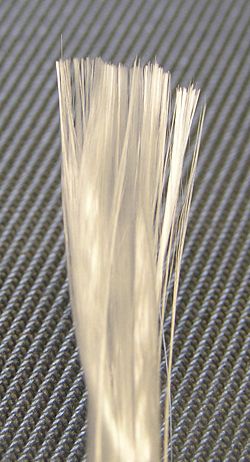
Bundle of glass fibers
Glass fiber (or glass fibre) is a material consisting of numerous extremely fine fibers of glass.
Glassmakers throughout history have experimented with glass fibers, but mass manufacture of glass fiber was only made possible with the invention of finer machine tooling. In 1893, Edward Drummond Libbey exhibited a dress at the World's Columbian Exposition incorporating glass fibers with the diameter and texture of silk fibers. Glass fibers can also occur naturally, as Pele's hair. (Full article...) -
Nikola Tesla (10 July 1856 – 7 January 1943) was a Serbian-American engineer, futurist, and inventor. He is known for his contributions to the design of the modern alternating current (AC) electricity supply system.
Born and raised in the Austrian Empire, Tesla first studied engineering and physics in the 1870s without receiving a degree. He then gained practical experience in the early 1880s working in telephony and at Continental Edison in the new electric power industry. In 1884, he migrated to the United States, where he became a naturalized citizen. He worked for a short time at the Edison Machine Works in New York City before he struck out on his own. With the help of partners to finance and market his ideas, Tesla set up laboratories and companies in New York to develop a range of electrical and mechanical devices. His AC induction motor and related polyphase AC patents, licensed by Westinghouse Electric in 1888, earned him a considerable amount of money and became the cornerstone of the polyphase system, which Westinghouse marketed. (Full article...) -
Augustin-Jean Fresnel (10 May 1788 – 14 July 1827) was a French civil engineer and physicist whose research in optics led to the almost unanimous acceptance of the wave theory of light, fully supplanting Newton's corpuscular theory, from the late 1830s until the end of the 19th century. He is perhaps better known for inventing the catadioptric (reflective/refractive) Fresnel lens and for pioneering the use of "stepped" lenses to extend the visibility of lighthouses, saving countless lives at sea. The simpler dioptric (purely refractive) stepped lens, first proposed by Count Buffon and independently reinvented by Fresnel, is used in screen magnifiers and in condenser lenses for overhead projectors.
Fresnel gave the first satisfactory explanation of diffraction by straight edges, including the first satisfactory wave-based explanation of rectilinear propagation. By further supposing that light waves are purely transverse, Fresnel explained the nature of polarization. He then worked on double refraction. (Full article...) -
Joel S. Levine (born 1942) is an American planetary scientist, author, and research professor in applied science at the College of William & Mary, specializing in the atmospheres of the Moon, Earth, and Mars. He has worked as a senior research scientist at NASA, developing scientific models of the evolution of the Earth's early atmosphere, as well as creating models of the Martian atmosphere for use during the Viking 1 and 2 Mars Orbiter and Lander Missions, and was principal investigator and chief scientist of the proposed ARES Mars Airplane Mission. He also formed and led the "Charters of Freedom Research Team," a group of 12 NASA scientists who worked with the National Archive and Records Administration (NARA) to preserve the United States Declaration of Independence, the Constitution, and the Bill of Rights when small white spots began appearing on the documents in 1988. Levine's past work also includes assisting in the design of the rescue vehicle that saved 33 Chilean miners in the 2010 Copiapó mining accident, as well as original research on the feasibility of the "nuclear winter" hypothesis, and the effects of uncontrolled fires on global warming.
Levine is married to Arlene Spielholz, a former NASA scientist who studied the psychological effects of astronauts spending long time periods in space, and has a daughter and grandson. (Full article...) -

Hendrik Antoon Lorentz (right) after whom the Lorentz group is named and Albert Einstein whose special theory of relativity is the main source of application. Photo taken by Paul Ehrenfest 1921.
The Lorentz group is a Lie group of symmetries of the spacetime of special relativity. This group can be realized as a collection of matrices, linear transformations, or unitary operators on some Hilbert space; it has a variety of representations. This group is significant because special relativity together with quantum mechanics are the two physical theories that are most thoroughly established, and the conjunction of these two theories is the study of the infinite-dimensional unitary representations of the Lorentz group. These have both historical importance in mainstream physics, as well as connections to more speculative present-day theories.
The development of the representation theory has historically followed the development of the more general theory of representation theory of semisimple groups, largely due to Élie Cartan and Hermann Weyl, but the Lorentz group has also received special attention due to its importance in physics. Notable contributors are physicist E. P. Wigner and mathematician Valentine Bargmann with their Bargmann–Wigner program, one conclusion of which is, roughly, a classification of all unitary representations of the inhomogeneous Lorentz group amounts to a classification of all possible relativistic wave equations. The classification of the irreducible infinite-dimensional representations of the Lorentz group was established by Paul Dirac's doctoral student in theoretical physics, Harish-Chandra, later turned mathematician, in 1947. Closely related work was published independently by Bargmann and Israel Gelfand together with Mark Naimark in the same year. (Full article...) -
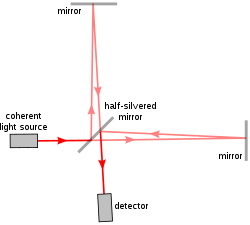
Figure 1. The light path through a Michelson interferometer. The two light rays with a common source combine at the half-silvered mirror to reach the detector. They may either interfere constructively (strengthening in intensity) if their light waves arrive in phase, or interfere destructively (weakening in intensity) if they arrive out of phase, depending on the exact distances between the three mirrors.
Interferometry is a technique which uses the interference of superimposed waves to extract information. Interferometry typically uses electromagnetic waves and is an important investigative technique in the fields of astronomy, fiber optics, engineering metrology, optical metrology, oceanography, seismology, spectroscopy (and its applications to chemistry), quantum mechanics, nuclear and particle physics, plasma physics, biomolecular interactions, surface profiling, microfluidics, mechanical stress/strain measurement, velocimetry, optometry, and making holograms.
Interferometers are devices that extract information from interference. They are widely used in science and industry for the measurement of microscopic displacements, refractive index changes and surface irregularities. In the case with most interferometers, light from a single source is split into two beams that travel in different optical paths, which are then combined again to produce interference; two incoherent sources can also be made to interfere under some circumstances. The resulting interference fringes give information about the difference in optical path lengths. In analytical science, interferometers are used to measure lengths and the shape of optical components with nanometer precision; they are the highest-precision length measuring instruments in existence. In Fourier transform spectroscopy they are used to analyze light containing features of absorption or emission associated with a substance or mixture. An astronomical interferometer consists of two or more separate telescopes that combine their signals, offering a resolution equivalent to that of a telescope of diameter equal to the largest separation between its individual elements. (Full article...) -

A kilogram mass and three metric measuring devices: a tape measure in centimetres, a thermometer in degrees Celsius, and a multimeter that measures potential in volts, current in amperes and resistance in ohms.
The metric system is a system of measurement that standardises a set of base units and a nomenclature for describing relatively large and small quantities using decimal-based multiplicative unit prefixes. Though the rules governing the metric system have changed over time, the modern definition, the International System of Units (SI), defines the metric prefixes and seven base units: metre (m), kilogram (kg), second (s), ampere (A), kelvin (K), mole (mol), and candela (cd).
An SI derived unit is a named combination of base units, such as the hertz (cycles per second), newton (kg⋅m/s2), and tesla (1 kg⋅s−2⋅A−1). In the case of degrees Celsius, it is a shifted scale derived from the kelvin. Certain units have been officially accepted for use with the SI. Some of these are decimalised, like the litre and electronvolt, and are considered "metric". Others, like the astronomical unit are not. Ancient non-metric but SI-accepted multiples of time, minute and hour, are base 60 (sexagesimal). Similarly, the angular measure degree and submultiples,
arcminute, and arcsecond, are also sexagesimal and SI-accepted. (Full article...) -

A waterspout near Thailand in 2016
A waterspout is a rotating column of air that occurs over a body of water, usually appearing as a funnel-shaped cloud in contact with the water and a cumuliform cloud. There are two types of waterspout, each formed by distinct mechanisms. The most common type is a weak vortex known as a "fair weather" or "non-tornadic" waterspout. The other less common type is simply a classic tornado occurring over water rather than land, known as a "tornadic", "supercellular", or "mesocyclonic" waterspout, and accurately a "tornado over water". A fair weather waterspout has a five-part life cycle: formation of a dark spot on the water surface; spiral pattern on the water surface; formation of a spray ring; development of a visible condensation funnel; and ultimately, decay. Most waterspouts do not suck up water.
While waterspouts form mostly in tropical and subtropical areas, they are also reported in Europe, Western Asia (the Middle East), Australia, New Zealand, the Great Lakes, Antarctica, and on rare occasions, the Great Salt Lake. Some are also found on the East Coast of the United States, and the coast of California. Although rare, waterspouts have been observed in connection with lake-effect snow precipitation bands. (Full article...)


.jpg)
February anniversaries
- 15 February 1564 – Galileo Galilei's birthday
- 18 February 1745 – Alessandro Volta's birthday
- 15 February 1786 – Cat's Eye Nebula discovered
- 18 February 1838 – Ernst Mach's birthday
- 11 February 1847 – Thomas Edison's birthday
- 23 February 1855 – Carl Friedrich Gauss's death
- 22 February 1875 – Heinrich Hertz's birthday
- 28 February 1901 – Linus Pauling's birthday
- 18 February 1967 – J. Robert Oppenheimer's death
- 13 February 1910 – William Shockley's birthday
- 15 February 1988 – Richard Feynman's death
- 28 February 2020 – Freeman Dyson's death
General images
-
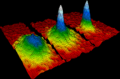 The first Bose–Einstein condensate observed in a gas of ultracold rubidium atoms. The blue and white areas represent higher density. (from Condensed matter physics)
 -
 Christiaan Huygens (1629–1695) (from History of physics)
 -
 Star maps by the 11th century Chinese polymath Su Song are the oldest known woodblock-printed star maps to have survived to the present day. This example, dated 1092, employs the cylindricalequirectangular projection. (from History of physics)
 -
 Classical physics (Rayleigh–Jeans law, black line) failed to explain black-body radiation – the so-called ultraviolet catastrophe. The quantum description (Planck's law, colored lines) is said to be modern physics. (from Modern physics)
 -
 Albert Einstein (1879–1955), ca. 1905 (from History of physics)
 -
 Heike Kamerlingh Onnes and Johannes van der Waals with the helium liquefactor at Leiden in 1908 (from Condensed matter physics)
 -

-
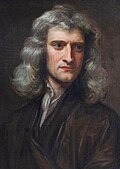 Sir Isaac Newton (1642–1727) (from History of physics)
 -
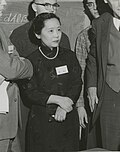 Chien-Shiung Wu worked on parity violation in 1956 and announced her results in January 1957. (from History of physics)
 -
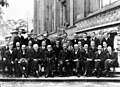 1927 Solvay Conference included prominent physicists Albert Einstein, Werner Heisenberg, Max Planck, Hendrik Lorentz, Niels Bohr, Marie Curie, Erwin Schrödinger, Paul Dirac (from History of physics)
 -
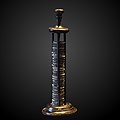 The Voltaic pile, the first battery was invented by Alessandro Volta in 1800 (from History of physics)
 -
-
 A Feynman diagram representing (left to right) the production of a photon (blue sine wave) from the annihilation of an electron and its complementary antiparticle, the positron. The photon becomes a quark–antiquark pair and a gluon (green spiral) is released. (from History of physics)
 -
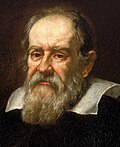 Galileo Galilei (1564–1642), early proponent of the modern scientific worldview and method (from History of physics)
 -
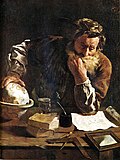 The ancient Greek mathematician Archimedes, developer of ideas regarding fluid mechanics and buoyancy. (from History of physics)
 -
 Composite montage comparing Jupiter (left) and its four Galilean moons (from top: Io, Europa, Ganymede, Callisto) (from History of physics)
 -
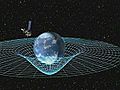 Einstein proposed that gravitation results from masses (or their equivalent energies) curving ("bending") the spacetime in which they exist, altering the paths they follow within it. (from History of physics)
 -
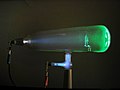 Crookes tube used to study cathode rays. It led to the discovery of the electron by J. J. Thomson. (from History of physics)
 -

-
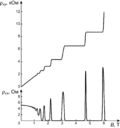 The quantum Hall effect: Components of the Hall resistivity as a function of the external magnetic field (from Condensed matter physics)
 -

-
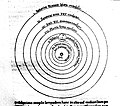
-
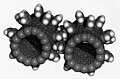 Computer simulation of nanogears made of fullerene molecules. It is hoped that advances in nanoscience will lead to machines working on the molecular scale. (from Condensed matter physics)
 -
 One possible signature of a Higgs boson from a simulated proton–proton collision. It decays almost immediately into two jets of hadrons and two electrons, visible as lines. (from History of physics)
 -
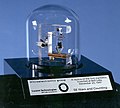
-
 James Prescott Joule's apparatus for measuring the mechanical equivalent of heat which the "work" of the falling weight is converted into the "heat" of agitation in the water. (from History of physics)
 -
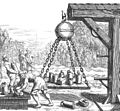 Magdeburg hemispheres, an experiment by Otto von Guericke where two metal hemispheres are held together by vacuum and cannot be separated even if large forces are applied. (from History of physics)
 -
 The Standard Model (from History of physics)
 -
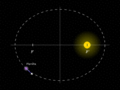 Johannes Kepler's first law of planetary motion states that planets move in elliptical orbits about the Sun. (from History of physics)
 -
 Newton's cannonball, a though experiment by Newton relating the motion of a projectile and orbiting of planets. (from History of physics)
 -
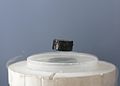 A magnet levitating above a high-temperature superconductor. Today some physicists are working to understand high-temperature superconductivity using the AdS/CFT correspondence. (from Condensed matter physics)
 -
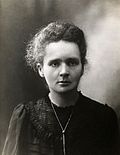 Marie Skłodowska-Curie
(1867–1934) received Nobel prizes in physics (1903) and chemistry (1911). (from History of physics) -
 Image of X-ray diffraction pattern from a protein crystal (from Condensed matter physics)
 -
-
 Hydrogen emission spectrum is discrete (here in log scale). The lines can only be explained with quantum mechanics. (from History of physics)
 -
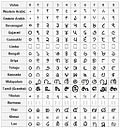 The Hindu-Arabic numeral system. The inscriptions on the edicts of Ashoka (3rd century BCE) display this number system being used by the Imperial Mauryas. (from History of physics)
 -
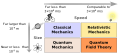 Classical physics is usually concerned with everyday conditions: speeds are much lower than the speed of light, sizes are much greater than that of atoms, yet very small in astronomical terms. Modern physics, however, is concerned with high velocities, small distances, and very large energies. (from Modern physics)
 -
 Maxwell's demon, thought experiment by James Clerk Maxwell to describe the kinetic theory of gases and describe how a microscopic creature could lead to violations of the second law of thermodynamics. (from History of physics)
 -
 Richard Feynman's Los Alamos ID badge (from History of physics)
 -
 An engraving of Benjamin Franklin's kite experiment used to study lightning. (from History of physics)


_in_1958.jpg)


.png)


.png)


.png)


Categories

Fundamentals: Concepts in physics | Constants | Physical quantities | Units of measure | Mass | Length | Time | Space | Energy | Matter | Force | Gravity | Electricity | Magnetism | Waves
Basic physics: Mechanics | Electromagnetism | Statistical mechanics | Thermodynamics | Quantum mechanics | Theory of relativity | Optics | Acoustics
Specific fields: Acoustics | Astrophysics | Atomic physics | Molecular physics | Optical physics | Computational physics | Condensed matter physics | Nuclear physics | Particle physics | Plasma physics
Tools: Detectors | Interferometry | Measurement | Radiometry | Spectroscopy | Transducers
Background: Physicists | History of physics | Philosophy of physics | Physics education | Physics journals | Physics organizations
Other: Fiction about physics | Physics lists | Physics software | Physics stubs
Physics topics
Classical physics traditionally includes the fields of mechanics, optics, electricity, magnetism, acoustics and thermodynamics. The term Modern physics is normally used for fields which rely heavily on quantum theory, including quantum mechanics, atomic physics, nuclear physics, particle physics and condensed matter physics. General and special relativity are usually considered to be part of modern physics as well.
More recognized content

Associated Wikimedia
The following Wikimedia Foundation sister projects provide more on this subject:
-
 Commons
Free media repository -
 Wikibooks
Free textbooks and manuals -
 Wikidata
Free knowledge base -
 Wikinews
Free-content news -
 Wikiquote
Collection of quotations -
 Wikisource
Free-content library -
 Wikiversity
Free learning tools -
 Wikivoyage
Free travel guide -
 Wiktionary
Dictionary and thesaurus


Sources
Portals on Wikipedia


